

Want to see how MiP fits your school?
See how to organise groups, prepare sessions and check attendance through the club, coach and player profiles. Tell us how you work so we can focus the demo on your day-to-day needs.
Request a demoA school can have full courts and still lose time to changes, messages and decisions made without context. We explore five organisational problems and practical ways to address them.
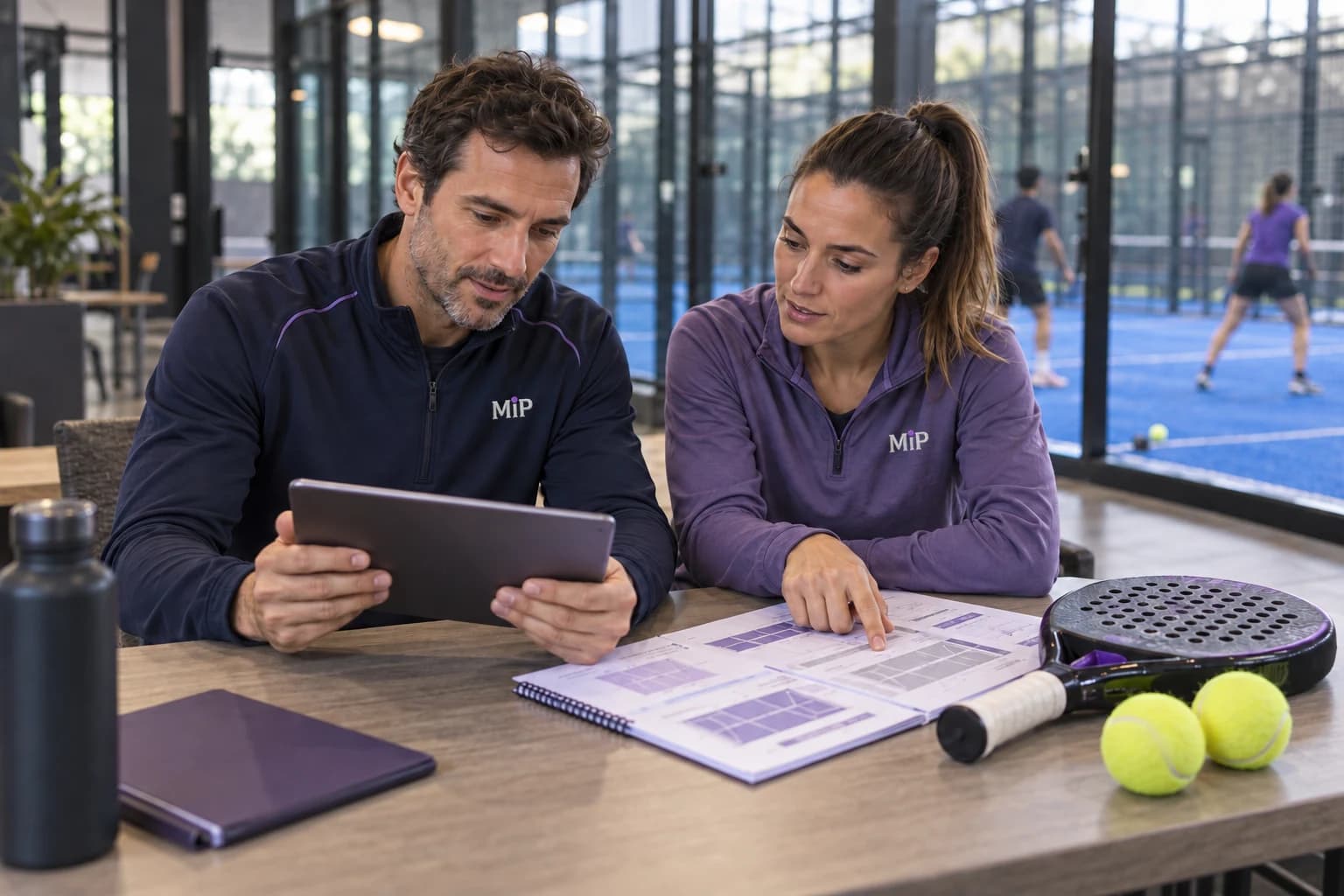
A padel school can have good facilities, qualified coaches and a full calendar of players. That does not necessarily mean it operates efficiently. As the number of groups and coaches increases, an approach that once worked may start to fall short.
Growth is about more than attracting new registrations. It also requires coordinating resources, maintaining consistent coaching and making the team's work easier. The problem is not always a lack of resources: sometimes it is how existing resources are used.
These five situations offer a starting point for reviewing padel school management. They do not occur at every club, and an app alone cannot solve them all. What matters is identifying where information is lost and agreeing on a concrete first change.
A coach may know their players' strengths and difficulties very well. However, if that knowledge exists only in their memory, sharing it with the rest of the team becomes difficult. When a player changes group or coach, some of that context can be lost.
The coaching director needs to know what is being worked on and what should be revisited. This does not mean turning every lesson into a test or giving a score after every shot. It means having reference points that support continuity in learning.
How to address it: agree on a simple way to record the group's objective, observations from the court and the next step. Decide who can access that information and when it will be reviewed. The coach's professional judgement remains essential.
For example, if the objective is improving shots after the ball rebounds off the back glass, a specific observation about positioning and shot selection is more useful than a general comment such as 'has improved'. Compare players with their own starting point and avoid recording information that will not be used.
Excel and WhatsApp can be useful. The difficulty arises when group lists are in one file, schedule changes are scattered across conversations and each coach keeps notes somewhere different. The information exists, but finding the current version requires asking around.
That fragmentation can create duplication and excessive dependence on particular people. Covering an absence becomes harder if only one person knows where everything is or which changes have been agreed.
How to address it: decide which source is authoritative for each type of information. The team should know where to check groups and sessions, where to communicate changes and who keeps those details up to date. Centralising does not mean copying the same information into one more tool.
Start with one process, such as attendance confirmations. Agree on where to check them and stop maintaining parallel lists for the same task. A small transition that everyone understands is usually more manageable than changing the entire operation at once.
A school depends on coordination between people with different responsibilities. Management organises and oversees; coaches prepare and deliver sessions; players need relevant information to take part.
When information does not flow, a coach may receive a change too late or a player may not know which session to attend. The issue is not always an unwillingness to communicate: often it is unclear what to share, through which channel and with whom.
How to address it: establish clear channels and procedures. Separate general club notices from group communications and agree on how issues are reported. Avoid sending the same message through several channels without knowing which is definitive.
Technology can support that exchange, but it cannot replace coordination between professionals. The aim is for information to support training and reach those who need it without adding unnecessary conversations or tasks.
Reorganising groups, reviewing schedules and maintaining continuity in coaching require both experience and information. When every decision depends on isolated impressions, it is harder to distinguish a one-off issue from a recurring situation.
How to address it: start with a few indicators and a question for each one. Attendance can help identify groups needing attention; prepared sessions and reviewed objectives support discussions about continuity. No figure alone explains why something happens.
Agree on how each piece of information is recorded and who reviews it. Do not confuse advance confirmation with actual attendance, or absence with a lack of interest. Speak to the team and players before drawing conclusions.
A useful indicator leads to a decision: review a schedule, adapt an activity or investigate an issue. If collecting it costs more than it contributes, simplify it. You do not need to start with a complex dashboard.
These five problems become harder to manage as activity grows. Digital tools can help, provided you first decide how you want to work. A shared tool cannot resolve a lack of clear criteria or responsibilities on its own.
At MiP Pádel, we connect club, coach and player around sporting activity. The platform lets you organise groups and sessions, check attendance and keep the team in touch. Its library of more than 1,500 drills supports training preparation with objectives and guidance on delivery.
These features support organisation. The coaching approach, interpretation of what happens on court and decisions about each player's development remain the responsibility of professionals. A demo is an opportunity to check what fits your school's particular way of working.
You do not need to change the whole school to start improving. Choose one problem, identify a recurring process and agree with the team on how to address it. Then review whether the change has made work easier.
It could be a single reference for schedules, a shared objective for each group or an attendance review before each lesson. What matters is that the procedure is understandable and remains in place when a coach changes or player numbers increase.
Growth also means managing better: preserving context, coordinating the team and using the information you gather to improve coaching. Filling courts is one part of the work; organising what happens on them is another.
See how to organise groups, prepare sessions and check attendance through the club, coach and player profiles. Tell us how you work so we can focus the demo on your day-to-day needs.
Request a demo